Pages

Tuesday, November 26, 2013

The Outback - Ashley, Grace


*
Source: http://www.airnewzealand.com.au/destination-australia
The Australian Outback is a desert ecosystem, compromising about ten major deserts. It is vast, arid, and dry. In fact, apart from Antarctica, Australia is the driest continent. The Outback is known as Australia's heartland, the basis of much of its culture and mythology. The diverse population of animals that are rarely found anywhere else makes this place unique. Some of the most widely known ones are kangaroos, koalas, and the platypus. When humans showed up in the area, even more animals were introduced, such as camels, rabbits, and the dingo (Australia).


Where is the Outback?

Source: http://www.dougsrepublic.com/australia/outback.php
The Outback covers about 70% of the continent, compromising most of Australia's desert range lands. However, there is no official boundary demarcating Outback lands from other regions (life/death/heartland). The map below is merely an approximation of the Outback limits.


History - Grace

Approximately ninety-seven million years ago, part of Australia was connected to Antarctica. The Australian Outback is known for its diverse vegetation and plant species. Many of the woody areas consisted of species that are grown to have characteristics to be able to survive cold winters. Certain plants are angled in specific ways to absorb the necessary amount of sunlight to survive. One example of the plant species were the conifers. Previous research has shown that conifers dominated certain areas (Hill 1540) due to major amounts of macrofossil conifers in one specific site.
Source: Hill, Robert S. "Origins of the Southeastern Australian Vegetation." Philosophical Transactions: Biological Sciences 359.1450 (2004): 1537-549. JSTOR. Web. 26 Nov. 2013.

Throughout the past, a lot of climate changes happened, which affected a lot of living species in the area. Historically, the Australian Outback was a very humid area with annual rainfall, which kept many of the plant species alive. But eventually, rainfall decreased while many species of plants had lowered drought tolerance. This previous observation gives a logical reason as to why so many plants have been disappearing.

Apart from its plant species, the Australian Outback was filled with animal species as well. A major part of it was the Dingo Fence, famous for being an incredibly long fence with its main purpose of prohibiting wild dogs from crossing. It reaches all the way from Darling Downs to the Nullarbor Plain (across part of the country), and was 5,600 kilometers long (Dingo 2). Originally, this was built in order to prevent the rabbit plague that was going on at the time from spreading across the borders but it was not as effective as hoped. Then, the main focus turned to preventing the wild dogs from getting to the sheep and cattle. Eventually, in the 1940s, this fence set the world record as being the longest one. The fence costs up to ten million dollars to maintain each year, but it has shown useful as it has successfully separated most wild dogs into one area of the country (Dingo 3)


Source: http://www.amusingplanet.com/2013/11/dingo-fence-australias-5600km-dog-fence.html

Current Human Impact - Ashley

Not much of these desert lands have been touched by humans. About 3% of the Australian population, or 574,000 people, occupies this area: 1% live in the arid zone, and 2% in the semi-arid zone (Wells 14,16). Most of these inhabitants are native Aboriginals; the rest are mostly white residents based there for various industries; these include miners, government workers, and service personnel. However, since European settlement nearly 200 years ago, much of the landscape of the Outback has been changed due to a variety of human activities which have led to averse effects on the biodiversity of the ecosystem. 


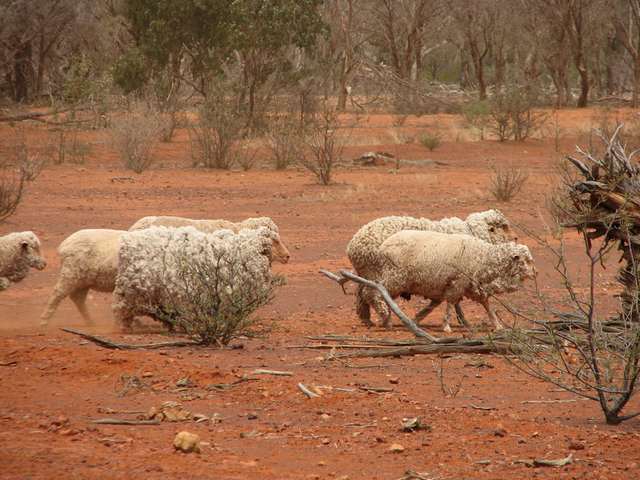
Grazing sheep (Source: http://www.opalhut.com.au/ausopals/outbacksheep.JPG )

Because the soil is not very suitable for agriculture, much of the Outback has primarily been used by people for the establishment of ranches, serving as grazing land for sheep, cattle, and rabbits. The extensive grazing has led to a loss of vegetation and soil fertility, in the form of desertification.This has led to the endangerment of smaller endemic mammals by over-consuming food resources and thinning the under-story layer used for shelter and protection by these mammals (Short 290). The land management methods and principles used also do not keep the long-term welfare of the land in mind, leading to a loss in perennial grasses.  Instead of realizing that fire is a necessary component in the maintenance of desert vegetation, these ranchers have tried to suppress it rather than learn how to use and control it. About 42% of the Outback is in a severe or very severe state of desertification (Ludwig 231). The table below illustrates the effect of desertification on the biodiversity in effected areas. In arid zones in which desertification is prominent, a large number of species are extinct. The majority of those being endangered are mammals.   

Source: Pickup, G. "Desertification and Climate Change—the Australian Perspective." Climate Research 11 (1998): 51-63. Web.


Extinct short-tailed hopping-mouse (Source: http://www.australianwildlife.org/Wildlife-and-Ecosystems/Australias-Biodiversity-Crisis.aspx )
The invasive foreign animals introduced by early settlers continue to plague species unique to Australia. Because it is an isolated land-mass, many species of plants and animals that are endemic to Australia have either gone extinct or are currently endangered. According to the Australian Wildlife Conservancy, more than 100 species of flora and fauna have been lost post-settlement; mainland Australia has lost 27 species of mammals endemic to this habitat (Threatened 1). An uncontrolled abundance of introduced foxes and feral cats prey on small ground-dwelling mammals like the desert rat-kangaroo, bilby, and burrowing bettong, which have all gone into extinction as a result. 

Mining in the semi-arid desert began in 1860s as an individual effort (Wells 43). Asian demand for minerals like copper, aluminum, iron, and gold, has led to a mining boom which has increased the population of this area with miners and other mining company employees (New 4-5). However, this boom has led to concern over impact on water in these areas. A drawdown effect around mines has caused vegetation and animal life to disappear due to the drying out of water, while  some other mines have forced water out from underground into creeks, causing abnormal vegetation growths (New 31-32). 


Oympic Dam mine. (Source: http://thesentimentalbloke.com/category/mining/)

Future Prospects - Grace

The Australian Outback is likely to become even more isolated ecologically due to the Dingo Fence that was created by humans in history. Currently, the fence still exists and is planned to be built even higher. Because of the existence of this fence, the entire country seems like two separated areas due to these major differences.
If many of what is going on today still goes on in the future, a lot of the living species in the area will become worse. This includes the excessive grazing throughout the Outback, which causes vegetation to decrease severely. These then cause a large competition for food for many of the animals that call the Outback home. The competition inevitably causes some animals to become exist and if this continues, animals that are still surviving today might become extinct in the future. Plants will continue to dry out due to the decreased rainfall. Many of the animal species will continue to become extinct.

Studies have been done that has shown the high likelihood in the Australian Outback changing visually so much that it might be unrecognizable compared to today (Outback 2) It seems that it will be very likely that areas that have trees will vanish, as there will be an increase in environments with more grassland. Much of these will be due to many different reasons, most of it due to changing climate.

What Can Be Done? - Ashley

In response to the negative impact humans have made, conservationists have raised support for protective measures for conservation by emphasizing the importance of the "heartland" that has formed the basis of Australian mythology and been a symbol of the spirit of survival in the Australian people (Gill 39). 

These measures include the control of invasive foreign animal species; the introduced fox, feral cat, and rabbits have possibly been the greatest factor in diminished populations of native species and even caused some of them to go extinct. Controlling these foreign species could be carried out several ways. The reinstatement of the dingo, the natural Australian predator, in these Outback areas would help control fox and cat numbers; research has shown that in areas where dingoes are dominant, less foxes are found and endangered species are more prevalent (Short 294). 


Invasive feral cat and fox. (Source: http://beforeitsgone.com.au/2011/01/05/report-your-local-ferals-during-january/ )
Another way in which the biodiversity threat to endemic species can be alleviated is through species reintroduction. One-third of the 27 species of extinct Australian mammals has managed to survive on offshore Australian islands; there is an opportunity to reintroduce them back onto the mainland in their original Outback environments (Threatened 1). Similarly, translocations, in which threatened species are brought out of the Outback to other areas for "safekeeping," also work to preserve the endangered. These translocated populations can then later be reintroduced back into the Outback areas when circumstances are more stable. 

Source: Short, Jeff, and Andrew Smith. "Mammal Decline and Recovery in Australia." Journal of Mammalogy 75.2 (1994): 288-97. JSTOR. Web. 25 Nov. 2013.
The table above shows the combination of translocation and foreign species control. If native species were brought into areas without foreign predators like the fox and cat, the success rate of their survival was astoundingly greater than that of species moved back into areas with these predators. This illustrates that the success of reintroduction is heavily reliant on the control of foxes and cats; the control of invasive species should be the larger priority. 

Land degradation and desertification caused by grazing pressures can be fixed by rehabilitation treatments to these lands that have become barren. Such treatments would aim to prevent water and nutrient loss by building ponding banks and contour furrows  to hold runoff water and keep soil from erosion (Ludwig 235). The grazing behind this desertification can be regulated if livestock numbers are decreased and controlled. Also, controlling fires to regularly maintain patches of shrub and decrease wildfires would also help to prevent desertification. 

In response to the water ecology problems brought on by the onset of mining, mining companies can aim to be more efficient in recycling the amount of water they consume. For example,  if a 10% reduction in freshwater consumption per ton of iron is achieved, water usage will stay the same even if the amount of iron extracted increases (New 35).


References

"Australian Animals: The Unique Animals Of Australia." Australian-Tales. N.p., n.d. Web. 26 Nov. 2013. <http://www.australian-information-stories.com/australian-animals.html>.
"Dingo Fence: Australia’s 5,600Km Dog Fence | Amusing Planet." Amusing Planet. N.p., 1 Nov. 2013. Web. 26 Nov. 2013. <http://www.amusingplanet.com/2013/11/dingo-fence-australias-5600km-dog-fence.html>.
Gill, Nicholas. "Life and Death in Australian ‘heartlands’: Pastoralism, Ecology and Rethinking the Outback." Journal of Rural Studies 21.1 (2005): 39-53. Science Direct. Web. 25 Nov. 2013.
Hill, Robert S. "Origins of the Southeastern Australian Vegetation." Philosophical Transactions: Biological Sciences 359.1450 (2004): 1537-549. JSTOR. Web. 26 Nov. 2013.
Ludwig, John A., and David J. Tongway. "Desertification in Australia: An Eye to Grass Roots and Landscapes." Environmental Monitoring and Assessment 37 (1995): 231-37. Web.
"New Australia Mining Boom Taking Toll on Outback Life." National Geographic. National Geographic Society, 26 Sept. 2007. Web. 25 Nov. 2013. <http://news.nationalgeographic.com/news/2007/09/070926-australia-mining.html>.
"Outback to the Future." The Grey Nomads. N.p., n.d. Web. 26 Nov. 2013. <http://thegreynomads.com.au/lifestyle/featured-articles/outback-to-the-future/>.
Short, Jeff, and Andrew Smith. "Mammal Decline and Recovery in Australia." Journal of Mammalogy 75.2 (1994): 288-97. JSTOR. Web. 25 Nov. 2013.
"Threatened Species Reintroductions." Australian Wildlife Conservancy. Australian Wildlife Conservancy, n.d. Web. 26 Nov. 2013. <http://www.australianwildlife.org/Conservation-Programs/Threatened-Species-Reintroductions.aspx>.


Wells, Kathryn. "The Australian Desert – the Outback of Australia." Australia.gov.au. Australian Government, n.d. Web. 25 Nov. 2013. <http://australia.gov.au/about-australia/australian-story/austn-desert-outback>.