Pages

Tuesday, November 26, 2013

Current Human Impact - Ashley

Not much of these desert lands have been touched by humans. About 3% of the Australian population, or 574,000 people, occupies this area: 1% live in the arid zone, and 2% in the semi-arid zone (Wells 14,16). Most of these inhabitants are native Aboriginals; the rest are mostly white residents based there for various industries; these include miners, government workers, and service personnel. However, since European settlement nearly 200 years ago, much of the landscape of the Outback has been changed due to a variety of human activities which have led to averse effects on the biodiversity of the ecosystem. 


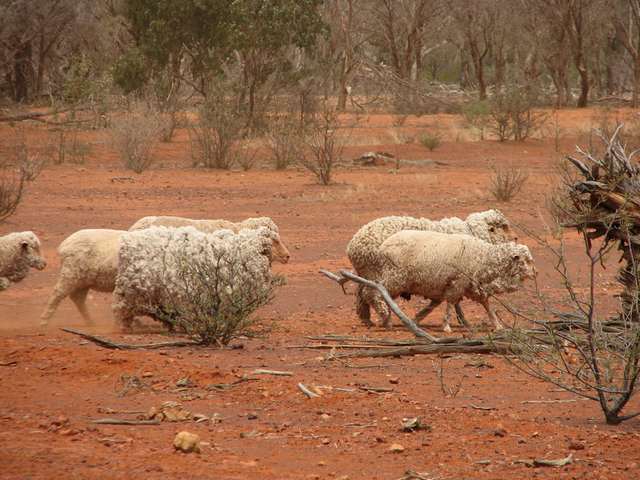
Grazing sheep (Source: http://www.opalhut.com.au/ausopals/outbacksheep.JPG )

Because the soil is not very suitable for agriculture, much of the Outback has primarily been used by people for the establishment of ranches, serving as grazing land for sheep, cattle, and rabbits. The extensive grazing has led to a loss of vegetation and soil fertility, in the form of desertification.This has led to the endangerment of smaller endemic mammals by over-consuming food resources and thinning the under-story layer used for shelter and protection by these mammals (Short 290). The land management methods and principles used also do not keep the long-term welfare of the land in mind, leading to a loss in perennial grasses.  Instead of realizing that fire is a necessary component in the maintenance of desert vegetation, these ranchers have tried to suppress it rather than learn how to use and control it. About 42% of the Outback is in a severe or very severe state of desertification (Ludwig 231). The table below illustrates the effect of desertification on the biodiversity in effected areas. In arid zones in which desertification is prominent, a large number of species are extinct. The majority of those being endangered are mammals.   

Source: Pickup, G. "Desertification and Climate Change—the Australian Perspective." Climate Research 11 (1998): 51-63. Web.


Extinct short-tailed hopping-mouse (Source: http://www.australianwildlife.org/Wildlife-and-Ecosystems/Australias-Biodiversity-Crisis.aspx )
The invasive foreign animals introduced by early settlers continue to plague species unique to Australia. Because it is an isolated land-mass, many species of plants and animals that are endemic to Australia have either gone extinct or are currently endangered. According to the Australian Wildlife Conservancy, more than 100 species of flora and fauna have been lost post-settlement; mainland Australia has lost 27 species of mammals endemic to this habitat (Threatened 1). An uncontrolled abundance of introduced foxes and feral cats prey on small ground-dwelling mammals like the desert rat-kangaroo, bilby, and burrowing bettong, which have all gone into extinction as a result. 

Mining in the semi-arid desert began in 1860s as an individual effort (Wells 43). Asian demand for minerals like copper, aluminum, iron, and gold, has led to a mining boom which has increased the population of this area with miners and other mining company employees (New 4-5). However, this boom has led to concern over impact on water in these areas. A drawdown effect around mines has caused vegetation and animal life to disappear due to the drying out of water, while  some other mines have forced water out from underground into creeks, causing abnormal vegetation growths (New 31-32). 


Oympic Dam mine. (Source: http://thesentimentalbloke.com/category/mining/)

No comments:

Post a Comment